Products
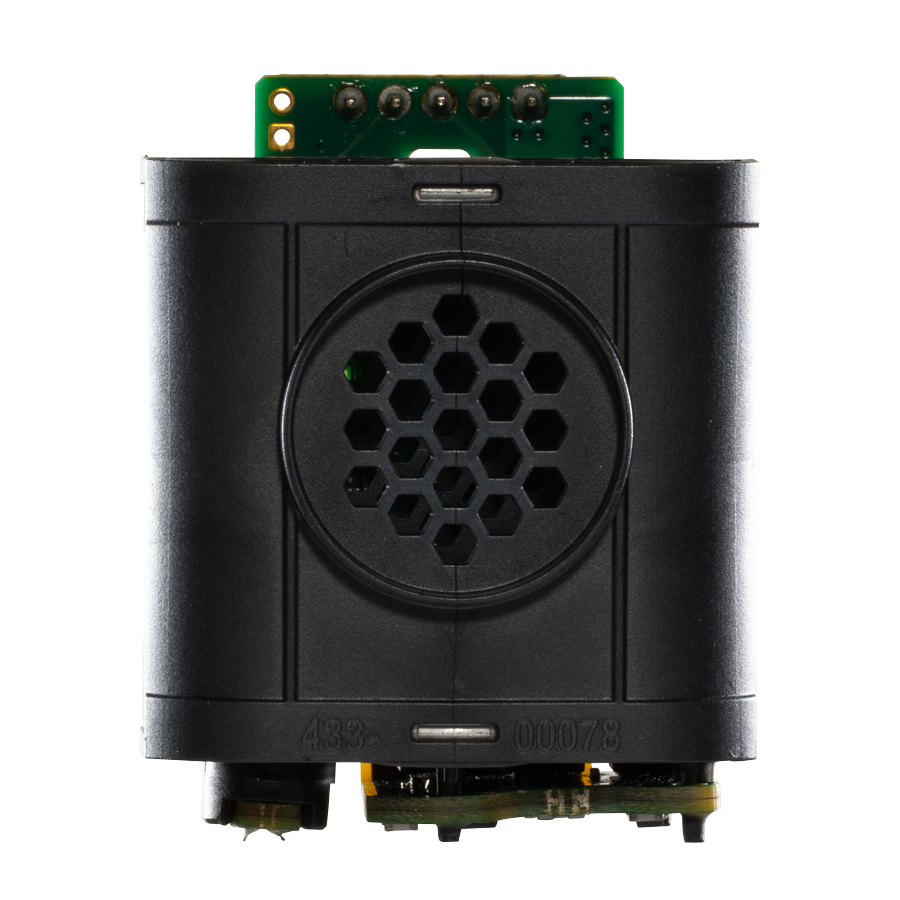
| Article number | Prototype |
| Operating principle | Three-channel non-dispersive infrared (NDIR) |
| Measured gas | CH₄, CO₂, H₂O, N₂O |
| Measurement range | 0–32 000ppm |
| Accuracy | ±30 ppm ±3 % of reading1 |
| Operating range RH | <95 % RH |
| Operation range °C | <50 °C |
| Response time T90 | 15 ±1 s |
| Power supply | 6 - 8.5 V |
| Peak current | 300 mA |
| Communication | UART |
| Maintenance | Periodic 1 point calibration |
- Except H₂O: ±(200 ppm + 3% of reading)
| Article number | Product | Description |
| Prototype | K96 Config 1 | N₂O, CO₂, H₂O |
| Prototype | K96 Config 2 | CH₄, CO₂, H₂O |
| Prototype | K96 Config 3 | CO₂, CO₂, H₂O |
What is Senseair K96?
Senseair K96 is a compact prototype multi-gas NDIR sensor that measures three gas species simultaneously in one device. It is developed for continuous gas monitoring where reliable data, low power consumption and deployability matter.
Which gases can Senseair K96 measure?
K96 can be configured for CO₂, N₂O or CH₄ measurement, with additional gas channels for H₂O and CO₂ depending on the configuration. This makes it possible to measure the target gas together with humidity or background gas information.
Is K96 a commercial product?
K96 is a prototype platform with preliminary specifications. Contact Senseair to discuss availability, configuration and application suitability.
What applications is K96 developed for?
K96 is developed for applications such as methane emissions monitoring, occupational safety, urban CO₂ monitoring and wastewater N₂O monitoring. It is suited for systems where gas measurement needs to move closer to the source, process or emission point.
Why combine three gas measurements in one device?
Combining three gas measurements in one device reduces system complexity, footprint and cost compared with solutions built around multiple instruments. It also makes deployment easier where continuous monitoring needs to be scaled across more measurement points.
Why does K96 measure H₂O together with CO₂, N₂O or CH₄?
Humidity can influence gas measurement and field conditions. Measuring H₂O together with the target gas helps create more reliable data in real-world environments.
Is K96 suitable for dense sensor networks?
Yes. K96 is compact, low power and designed for deployment where more measurement points are needed. This makes it relevant for dense CO₂ monitoring networks, distributed emissions monitoring and field-deployed gas sensing systems.
Calibration Certificate
Related News & Insights

How Senseair Drives Quality and On-Time Delivery

Senseair S12 crowned the winner