The Development of S12
Shrinking True NDIR
Innovation rarely happens by accident. At Senseair, the creation of the groundbreaking S12 micro-sensor was the result of deep fundamental physics, intensive material research, and rigorous engineering. By combining theoretical research with practical mass-production capabilities, the team achieved what was once thought impossible in the world of gas sensing.
The “Mini-University” and the Eraser Prototype
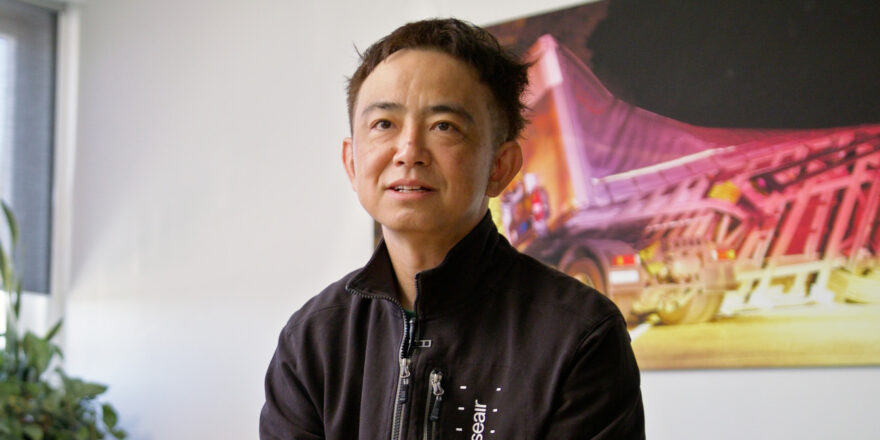
For two decades, Henrik Rödjegård, Research Manager at Senseair, has been a driving force within the research department, a team that operates much like an in-house ‘mini-university.’ This team of scientists focuses on building a complete knowledge set in optics, physics, and electronics, pushing the boundaries of what Non-Dispersive Infrared (NDIR) technology can do.
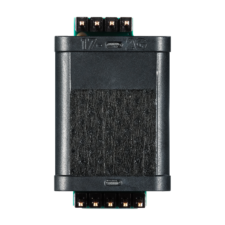
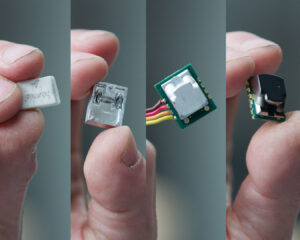
Rather than starting with a complex digital model, the initial spark for S12 was a rough physical concept carved out of an everyday eraser (see the prototype evolution in the image below). This simple block of rubber set the physical parameters for the project before they eventually grinded the initial optics into metal to verify the concept.
Confirming the Market Need
While the team had been exploring and developing the idea of smaller sensors for years, direct feedback from customer meetings provided the exact validation they needed. The feedback underscored a massive, unmet market need: a highly integrable, chip-scale sensor that didn’t sacrifice the high performance found in larger models. With the market demand clearly verified, the vision was set, but turning that vision into hardware would prove to be an enormous challenge.
From Prototype to Production
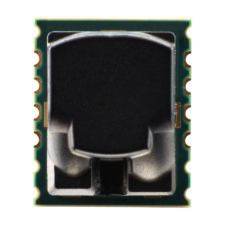
To make S12 a reality, the team had to compress an 8 cm light path into a tiny micro format. They achieved this by evolving their 3D White cell into a single, solid piece of highly rigid plastic.
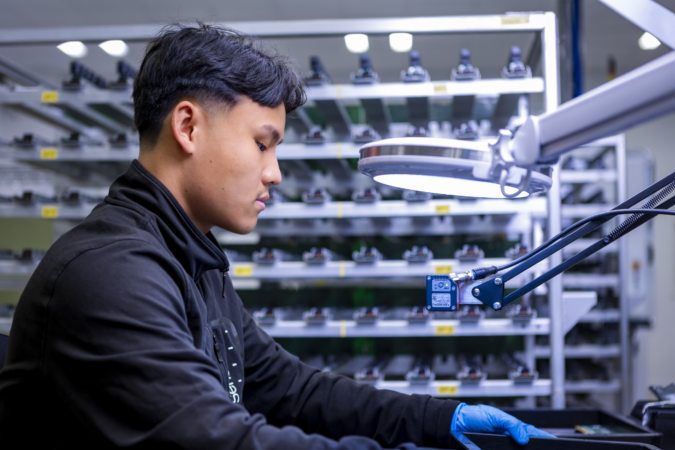
Moving from a research prototype to a fully realized product required a massive effort. Martin Gombrii, Head of Product Development at Senseair, explains that their role relies heavily on craftsmanship, taking an early stage prototype and turning it into a quality assured product that can be reliably delivered in mass volumes. The team faced the monumental task of doing everything at once: developing one of the world’s smallest and most power efficient NDIR sensors while simultaneously creating entirely new calibration and production systems.
One of the team’s biggest achievements, however, was mastering reflow soldering. Because the sensitive plastic optical chambers of gas sensors traditionally melt or deform when subjected to the extreme heat of automated reflow ovens, Senseair’s research team embarked on an intensive material science journey to find a specialized new plastic that could survive this heat without optical degradation. This breakthrough was made possible through a close collaboration with material experts from AKM.
The successful implementation of this reflow capability fundamentally changes the game for integrators. Gombrii emphasizes that this feature drastically simplifies the assembly process for the customer. Instead of relying on slow, traditional hand soldering or selective soldering robots, customers can now mount S12 just like any standard chip. “You just have an automated hand that puts it on the board and runs it through the soldering oven,” Gombrii notes, adding that this allows customers to achieve completely different, much higher production volumes.
Unlocking Miniaturization with AKM
Why couldn’t S12 have been built ten years ago? The answer lies in the components. The extreme miniaturization of S12 was finally made possible by accessing next generation LEDs and photodetectors from Senseair’s parent company, Asahi Kasei Microdevices (AKM). Adapting the optical ideas from previous sensors to fit these smaller infrared lamps and detectors perfectly balanced the system.
A Special Sensor and Unprecedented Demand
What makes S12 truly special is its unique market position. No one else offers this level of NDIR focused performance combined with such a small size and competitive price point. The industry’s response was immediate. Anticipating this immense market interest, the project team was fully prepared to deliver thousands of prototypes long before the official launch. This early demand proved they had built a solution the market clearly needed.
When asked about the feeling of finishing the project, the perspectives differ between research and production. For Gombrii on the product development side, a product is never truly finished, as there are always ongoing challenges to solve. For Henrik Rödjegård, however, holding the first functional prototype was a moment of pure realization. The performance was exactly as good as they had calculated. Looking back at the long journey from an eraser to a revolutionary micro sensor, Henrik summarized the triumph simply: “It’s really our research visions that has been turned into a little beautiful product. I’m so damn proud.”