Exploring Use Cases for the K96
From Healthcare Safety to Climate Action
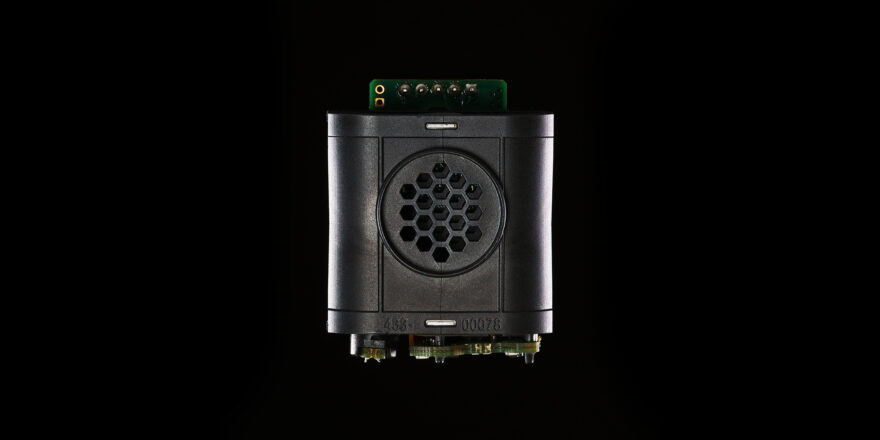
The Senseair K96 is a compact multi-gas sensor that can measure three gases simultaneously. Based on advanced 3-channel non-dispersive infrared (NDIR) technology, it delivers high-resolution, reliable measurements in an efficient format.
By combining these gas measurements into a single sensor, the K96 reduces system complexity, footprint, and overall costs for integrators. It boasts sub-PPM resolution, is immune to poisoning, and maintains reliable performance over time, which minimizes the need for complex data correction and heavy maintenance.
Because of this highly adaptable platform, the K96 is opening doors to new, scalable monitoring solutions across a variety of industries. Here is an exploration of some use cases for the K96.
Occupational Safety in Healthcare
In medical environments, nitrous oxide (N₂O) is a rapid, controllable gas commonly used for general anesthesia, procedural sedation, and the treatment of severe pain. While it is safe and effective when properly monitored, continuous measurement is vital to limit occupational exposure risks for healthcare staff.
To protect these workers, various organizations have established strict safety guidelines. The U.S. National Institute of Occupational Safety and Health (NIOSH) recommends capping exposure at a 25 ppm Time-Weighted Average (TWA) over an 8-hour shift, while the American Conference of Governmental Industrial Hygienists (ACGIH) sets a slightly higher 50 ppm threshold. Because there is no universally binding occupational exposure limit across the EU, many European healthcare facilities voluntarily adopt the 25 ppm NIOSH recommendation as their practical daily safety target.
The K96 Advantage: The K96 enables accurate ambient monitoring with a low detection limit of less than 1 ppm and a high precision of approximately 0.1 ppm.

Wastewater Treatment Plants
Wastewater treatment plants play a surprisingly critical role in global greenhouse gas emissions. Nitrous oxide (N₂O) is a powerful greenhouse gas with a global warming potential 273 times higher than CO₂, and the waste and wastewater sector accounts for around 3–5% of human-related N₂O emissions. Because these treatment processes are highly controllable, they hold massive potential for meaningful climate impact.
Historically, continuous N₂O monitoring has been bulky, resource-intensive, and wildly expensive. The Senseair K96 changes the paradigm by introducing equivalent or better performance at a fraction of the cost. By enabling cost-effective, real-time monitoring of crucial gases, it allows operators to track emissions dynamically and optimize their processes.

Urban CO₂ Monitoring
Cities currently account for an estimated 70% to 80% of global CO₂ emissions. This proportion is expected to grow rapidly, with two-thirds of the human population projected to inhabit cities by 2050. To support global objectives of reducing greenhouse gases, understanding urban emissions at a granular level is critical.
Traditionally, cities relied on a small number of costly, high-precision instruments that provided good regional data but could not map fine-scale variability. Dense urban networks using lower-cost sensors are now emerging as the standard to identify emission hotspots and verify the efficiency of local climate actions.
The K96 is a great choice to meet this demand, providing great accuracy with a high CO₂ precision of approximately 0.1 ppm. Its reliability is well-documented; an evaluation by the EU Joint Research Center found that the measurement uncertainty of the K96 was three times smaller than the lowest measurement uncertainty claimed by other manufacturers of low-cost CO₂ sensors on the market.
Thanks to this proven accuracy, the K96 has already been successfully integrated into major urban monitoring networks in cities like Paris and Zurich.
Tackling Methane (CH₄) Emissions
Methane is an important greenhouse gas and because it is relatively short-lived in the atmosphere, lasting only about 12 years, reducing CH₄ emissions can deliver rapid and highly significant climate benefits.
The K96 provides continuous, cost effective CH₄ monitoring across several vital sectors. In the oil and gas industry, continuous monitoring is essential to detect leaks and repair infrastructure in order to comply with increasingly stringent regulations. The K96 is actively being used in these field sensor networks.
This technology is also driving agricultural innovations. With the agricultural sector accounting for 48% of total CH₄ emissions in the EU, the K96 has been deployed in livestock farms, to evaluate greenhouse gas monitoring techniques for enhanced spatial and temporal coverage. A major advantage of the K96 across all these applications is its detection capability through the simultaneous measurement of CH₄, CO₂, and H₂O. By natively applying corrections for H₂O cross interference, the K96 greatly improves measurement accuracy, matching the performance of much more expensive reference instruments and detecting enhancements of just a few ppm in background signals.
Ready to elevate your monitoring network? Contact Senseair today to learn more.
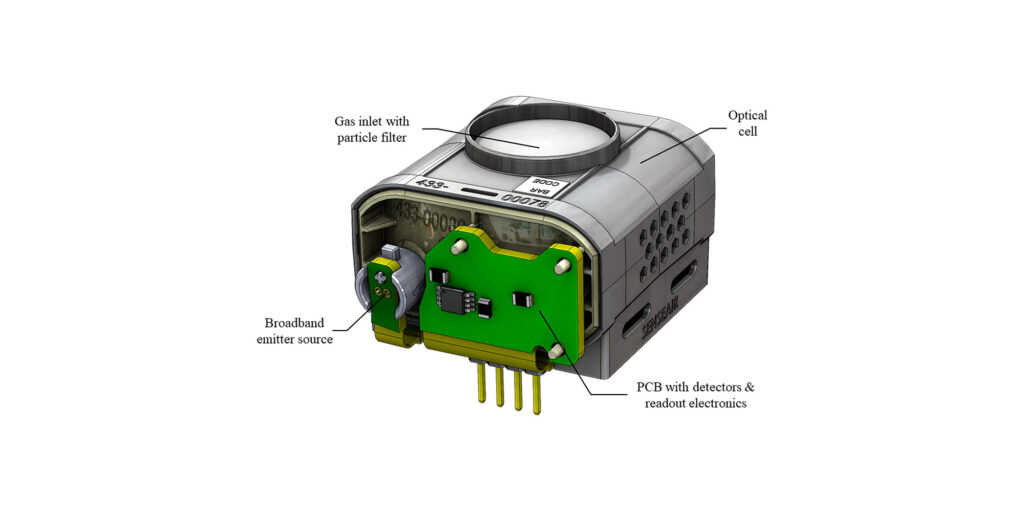
Figure: CAD view of the K96 sensor core, including the optical cell and integrated electronics.